Kids' Room Organization Ideas: A System Kids Can Actually Maintain
Age-by-age storage strategies that let kids clean up on their own — labeled bins, low shelves, rotating toys, and the two rules that keep the whole system working.

A kids' room that stays organized is not about buying more storage — it's about making a system a five-year-old can execute. If cleanup requires an adult, cleanup won't happen. These strategies come from organizing three kids' rooms across seven years and unlearning most of what Pinterest suggested.
Two rules that make it work
Everything in a kids' room follows two rules: (1) if a child can't put it away independently, they won't; (2) fewer things visible at once means calmer play and easier cleanup. Every decision below flows from those two rules. Ignore them and the prettiest system will collapse within a month.
Step 1: Purge in three piles
With the child if they're old enough, without them if they're not, sort every toy and item into three piles: love, sometimes, and no. The "no" pile goes immediately — donate, trash, or hand-down. The "sometimes" pile goes into rotation storage (see step 5). Only the "love" pile stays out. Most kids' rooms have 3× more toys visible than the child ever plays with.
Step 2: Sort by category, not size
Group like with like: all Legos together, all art supplies together, all stuffed animals together, all pretend food together. Category-based storage is the only kind kids can maintain — they cannot remember which bin holds "medium plastic things." One bin per category, clearly assigned.
Step 3: Everything low and open
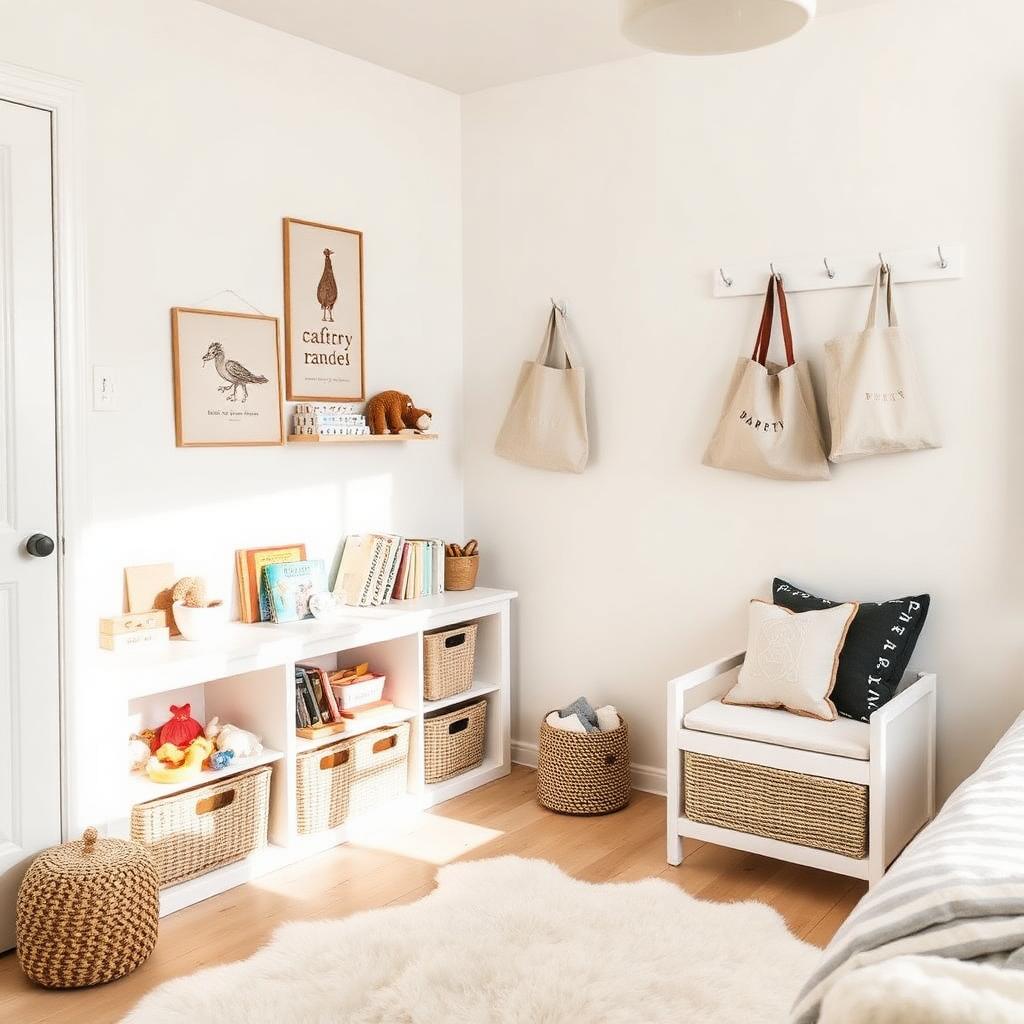
Any storage above a child's chin is decoration, not function. Low open shelves (Ikea Trofast, Kallax on its side, or plain white cube shelves) at kid height are the backbone of a maintainable kids' room. High shelves are fine for adult-managed items (extra crafts, books to swap in) but daily-use stuff must be accessible.
Step 4: Picture labels for pre-readers
Every bin gets a label with both a picture and a word. Pre-readers match the picture; older kids read the word; the transition is automatic. Take photos of what actually goes in each bin (not stock icons — kids don't always translate). Laminate and Velcro so labels change when contents do.
Step 5: Rotate 30% of toys
Take one out of every three toys out of the room and put them in labeled bins in a closet or garage. Rotate every 4–6 weeks. Two things happen: the room stays visually calm, and re-appearing toys feel new. Kids play longer and more creatively with fewer options at once — this is one of the most-studied findings in early childhood research.
Step 6: Clothes they can dress themselves in
Hang minimal — most kids' clothes fold better than they hang. Use drawer dividers to create sections (shirts, pants, underwear, pajamas) and keep only current-season clothes accessible. Off-season clothes and outgrown items go in labeled bins on a top shelf or under the bed. A child who can find their own underwear at 6 a.m. is a gift to the whole family.
Front-facing books
Regular spine-out shelving is how kids stop reading books. Front-facing displays (a picture ledge, a small book cart) show covers, and covers are what makes a child pick up a book. Rotate 5–8 books out weekly; store the rest in a nearby bin or closet. Same book-to-space ratio as a bookstore endcap, and it works for the same reason.
Step 8: A dedicated quiet corner
Even in a small room, carve out one 4×4-foot corner as a quiet zone — a beanbag or floor cushion, a soft rug, a small basket of books, and a wall sconce or clip-on lamp. Signals to the child (and the adults) that this corner is for calm activities. Kids who have a quiet spot use it; kids who don't will find one somewhere adults don't want them to.
Adjustments by age
Ages 2–4: extreme category simplicity — 6–8 bins total. Big open baskets, no lids. Ages 5–8: add labeled sub-bins for detail categories (art supplies, small figures). Introduce a clothes drawer they own. Ages 9–12: child leads the organization decisions; adult supports. Add a homework/desk zone. Reduce toys, expand hobby storage. Teens: hand the whole room over. Your job is boundaries (clean once a week, no food that grows mold), not systems.
The nightly five-minute cleanup
End every day with a five-minute cleanup, done together for younger kids, done independently by school-age kids. Set a timer, play a song. This one habit is worth more than any storage system — it keeps mess from compounding overnight and turns cleanup into a routine, not a battle.
Common mistakes
Three that come up over and over: buying too much cute storage (fewer bigger bins beat many small ones), high shelves for daily items (kids can't reach = won't put away), and labeled bins with words no one can read (add pictures). Fix all three and most kids' rooms self-organize.
Frequently asked questions
- How many toys should a child have?
- Fewer than you think — most researchers suggest 15–25 accessible at a time. Rotate the rest so the visible set stays fresh.
- What age can kids clean their own room?
- Age 3 with heavy scaffolding; age 5 independently for simple pickup; age 8+ for full cleanup including making the bed.
- How do you organize a shared kids' room?
- Give each child their own labeled storage (colors help), share only truly communal items like the book collection, and set individual cleanup responsibilities.
Frequently asked questions
- How many toys should a child have?
- 15–25 accessible at a time; rotate the rest so the visible set stays fresh.
- What age can kids clean their own room?
- Age 3 with help, 5 for simple pickup, 8+ for full cleanup.
- How do you organize a shared room?
- Give each child their own labeled storage (colors help), share only truly communal items.