Home Energy Efficiency: 9 Upgrades Ranked by Real Payback
Every energy upgrade promises savings. These nine actually deliver — ranked by payback period using current 2026 cost and utility data.

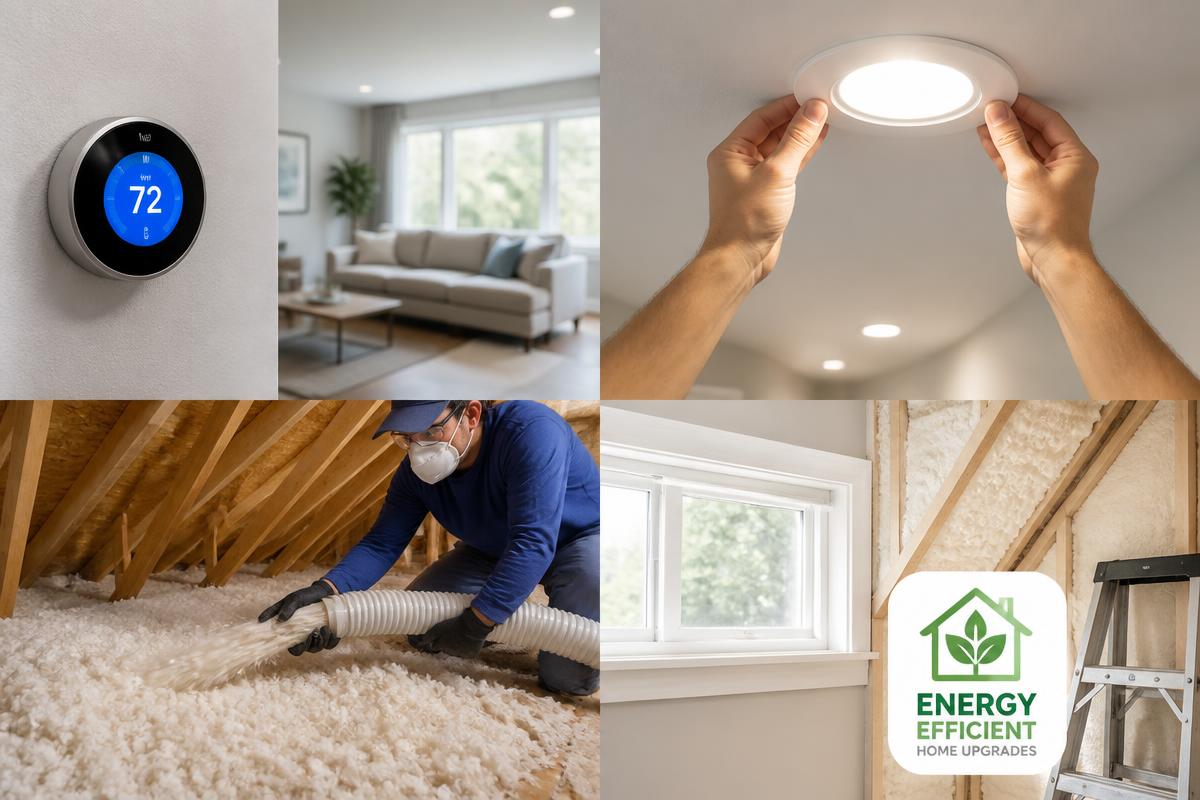
Home energy upgrades vary wildly in real-world payback. Some return their cost in under two years; others take twenty. The list below is ordered by simple payback period — how long until utility savings repay the investment — based on 2026 average U.S. installation costs and electricity rates.
How we ranked these
Payback = total installed cost ÷ annual utility savings. We assume an average single-family home (2,000 sq ft, electric + gas), national-average rates, and current federal Inflation Reduction Act incentives where applicable. Your numbers will vary by climate zone and utility rates — always get a local energy audit before committing to the big-ticket items at the bottom of this list.
1. Air sealing — payback under 1 year
The cheapest, highest-ROI upgrade in any home. A few tubes of caulk and a can of low-expansion spray foam, sealing around windows, doors, recessed lights, and the rim joist in the basement, typically cuts heating and cooling bills 10–15%. DIY cost: under $100. Annual savings: $150–400.
2. Attic insulation — payback 2–4 years
If your attic has less than R-30 (about 10 inches of blown cellulose), topping it up to R-49 or R-60 is one of the best dollar-for-dollar upgrades available. Costs $1,500–3,000 installed; saves $300–600/year in most climates.
3. Smart thermostat — payback 2 years
A learning thermostat saves an average of 8% on heating and 10% on cooling by adjusting setpoints when you are asleep or away. $150–250 installed; $100–200/year savings.
4. LED lighting — payback 1–3 years per fixture
If you still have any incandescent or halogen bulbs, swapping the most-used fixtures pays back in months. Whole-house conversion typically saves $100–200/year.
5. Heat pump water heater — payback 4–7 years
3–4x more efficient than standard electric resistance water heaters. Installed cost is $2,500–4,500 (often offset by IRA rebates of up to $1,750 for income-qualifying households), saving $300–500/year. Best in basements or garages in moderate climates.
6. Windows — payback 15–30 years (be honest about this)
Replacing single-pane windows with double-pane low-E windows costs $400–1,200 per window installed and saves only $100–300 per year for the whole house. The decision is usually about comfort, noise, and aesthetics — not energy payback. Don't let a contractor tell you otherwise.
7. Heat pump HVAC — payback 6–12 years
A ducted or ductless heat pump replacing both a gas furnace and central AC can cut HVAC energy use 40–60%. With IRA tax credits of up to $2,000 and many utility rebates, payback drops significantly. Best when an existing system is at end-of-life anyway.
8. Induction cooktop — payback rarely happens financially
Induction uses ~10% less energy than electric resistance and significantly less than gas, but cooking is a small share of total home energy use. Buy induction for the cooking experience and indoor air quality, not the utility bill.
9. Rooftop solar — payback 6–10 years (highly location-dependent)
With the 30% federal tax credit, a typical 7kW system costs $14,000–18,000 net, generating $1,500–2,500/year in electricity in sunny markets. In low-sun, low-electricity-cost regions, payback can stretch to 15+ years. Get three local quotes and confirm net-metering rules before signing.
Start with an energy audit, not a shopping list
The single most cost-effective first step is a professional energy audit — often free or under $200 through your local utility. An auditor uses a blower door test and infrared camera to find exactly where your home is leaking air and heat, which turns vague intuition ("the upstairs is always cold") into a ranked list of fixes specific to your house. Skipping the audit and jumping straight to a heat pump or solar panels routinely wastes thousands of dollars on upgrades that would have paid back faster after sealing and insulation went in first.
Stack federal, state, and utility incentives
The 2026 incentive landscape rewards stacking. The federal Inflation Reduction Act provides up-front rebates and tax credits for heat pumps, heat pump water heaters, insulation, electrical panel upgrades, and induction ranges, often covering 30–100% of cost for income-qualifying households. Many states layer additional rebates on top, and most utilities offer instant or mail-in rebates for ENERGY STAR equipment. Before you sign any contract, spend an hour at the DSIRE database (dsireusa.org) entering your ZIP code — the combined savings can change which upgrades make financial sense and in what order.
The right order of operations
Energy upgrades have a clear best sequence, and doing them out of order leads to oversized, overpriced equipment:
- Air sealing — caulk, foam, weatherstripping. Days, not weeks.
- Insulation — attic first, then rim joist, then walls if accessible.
- Controls and lighting — smart thermostat, LED conversion.
- Mechanical upgrades — heat pump water heater, then heat pump HVAC, sized for the now-tighter envelope.
- Generation — solar last, sized for the now-lower load.
Installing solar before sealing and insulation means buying a system 20–40% larger than you actually need. Replacing HVAC before sealing means installing oversized equipment that short-cycles, runs inefficiently, and wears out faster.
Common myths that waste money
"Closing vents in unused rooms saves money." It actually unbalances the duct system and reduces overall efficiency. Leave vents open and turn down the central setpoint instead.
"Setting the thermostat to a constant temperature uses less energy." The opposite — every degree of setback for 8+ hours saves measurable energy. A smart thermostat manages this automatically.
"Tankless water heaters always save money." They use less energy than a tank heater, but a heat pump water heater beats both in efficiency and is usually a better investment unless gas is your only option.
"New windows have great payback." Discussed above — comfort and noise, not energy, justify the spend in almost every climate.
When to call a contractor instead
The line between DIY-friendly and contractor-required is reasonably clear. Sealing, insulation, smart thermostats, LED swaps, and induction range installation (if the circuit exists) are all within reach for a confident homeowner with a weekend. Heat pump HVAC, heat pump water heaters when a new circuit is needed, electrical panel upgrades, and solar are not DIY projects in any meaningful sense — they require permits, manufacturer-certified installers to maintain warranty coverage, and integration with utility interconnection processes. Trying to save money by self-installing the larger systems usually voids the federal incentives and the equipment warranty, which more than wipes out any labor savings.
Frequently asked questions
Frequently asked questions
- What's the single best energy upgrade I can do this weekend?
- Air sealing. A weekend with a caulk gun and a can of spray foam, working around windows, doors, attic hatches, and basement rim joists, will pay back in under a year and meaningfully improve comfort.
- Are heat pumps worth it in cold climates?
- Yes. Modern cold-climate heat pumps maintain over 100% efficiency down to -5°F and competitive efficiency well below that. They are now the default recommendation in most U.S. climate zones.