Small Living Room Layout Ideas That Actually Work (Designer-Tested)
Ten layout strategies that make a small living room feel twice its size — based on a decade of working in apartments under 400 square feet.

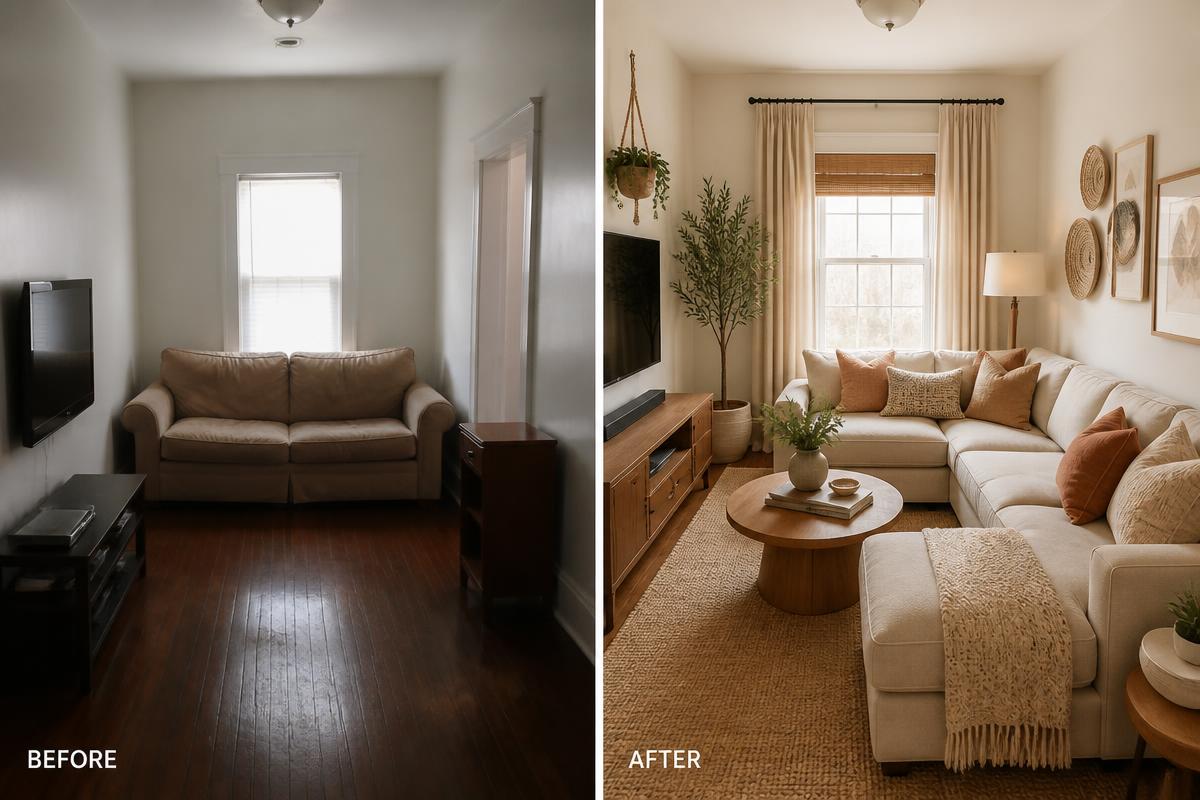
A small living room is not a design problem — it is a decision problem. Most cramped rooms I'm asked to fix are not too small; they are stuffed with the wrong pieces, arranged against the wrong walls, anchored by the wrong rug. After ten years writing about small-space interiors and renovating a 380-square-foot Portland studio I share with my partner, these are the ten layout choices I rely on every single time.
1. Float the sofa away from the wall
The single biggest mistake in small rooms is shoving every piece of furniture against a wall. It reads as a waiting room, not a living room. Pulling the sofa even 8–12 inches off the wall creates a slim gallery behind it for a console, a row of books, or a tall lamp — and it lets the room breathe. In a true square room, floating the sofa in the middle and putting a low console behind it as a "wall" can create two zones (lounge + work) in one footprint.
2. The 2-by-3 furniture rule
Limit yourself to two large pieces and three small ones. In a typical 11×13 living room that is: one sofa, one armchair (large), plus a coffee table, a side table, and an ottoman (small). Anything beyond that and the eye has nowhere to rest. The rule sounds restrictive; in practice it removes the friction of deciding what to cut.
3. Use the walls, not the floor
Floor-standing bookcases eat the only commodity you don't have: square footage. Wall-mounted shelves at 60–72 inches up draw the eye vertically and free the floor for movement. Run a single picture ledge the full width of the longest wall — it reads as architecture, not clutter, and gives you a rotating display surface for art, books, and plants.
4. Buy a rug one size up
The most common rug error in small rooms is buying one too small, which makes the room shrink visually. The rug should slip under the front legs of every major seating piece. In a 10×12 room, that almost always means an 8×10 rug — not a 5×7. Counterintuitive, but a larger rug unifies the floor plane and makes the room read as one generous zone.
5. Layer three light sources
One overhead light flattens a small room and emphasizes how small it is. Three sources at three heights — a ceiling fixture, a table lamp, and a floor lamp or sconce — create depth. Put each on a separate switch or smart plug so you can dim the overhead and let the lower sources do the work in the evening. Warm bulbs (2700K) consistently make small rooms feel larger than cool 4000K bulbs do.
6. Try the diagonal layout
If your room is awkward — say, with two doorways on adjacent walls — angle the sofa across a corner. The triangle of dead space behind it disappears behind a tall plant or floor lamp, and the diagonal sightline is the longest line in the room, which the eye reads as spaciousness.
7. Demand two jobs from every piece
A coffee table with a lift-top becomes a desk. An ottoman with a hinged lid becomes a toy bin. A bench under the window becomes seating and shoe storage. In a small room, single-purpose furniture is a luxury you can rarely afford. Before buying anything, write down the second job it has to do.
8. Match scale to ceiling height
Low-profile furniture (sofas under 32" tall, armless chairs, slim coffee tables) is the standard small-room advice — and it is mostly right. But under a 10-foot ceiling, very low furniture looks like a doll's house. The principle is proportion, not minimization: pick pieces that leave roughly one-third of the wall visible above them.
9. Use a tight color story
Three colors total, plus wood and metal. A small room with five paint colors, three throw pillow patterns, and a busy rug reads as chaos. A small room with one wall color, one upholstery color, and one accent (terracotta, mustard, deep green) reads as intentional. Repeat each color at least twice so the eye has somewhere to land.
10. Protect the empty space
The hardest discipline in a small room is leaving space empty. A blank corner, an empty wall above the sofa, a coffee table with just one object on it — these are not problems to solve. They are what makes the room feel calm. Resist the urge to fill them. If you have to put something there, make it one large piece (a tall plant, a single big artwork) rather than a cluster of small ones.
The three mistakes I see most often
After hundreds of small-space consultations, the same three errors come up again and again. First, buying furniture sized for the showroom, not the room — a sofa that looked compact in a 2,000 sq ft store overwhelms a 12-foot wall at home. Always tape out furniture footprints on the floor with painter's tape before ordering. Second, treating "small" as a style. A small room does not need to be all white, all minimal, or all clever multi-functional furniture; it needs to be edited. A small room with one bold color, real art, and considered objects almost always reads larger than the same room stripped bare. Third, forgetting circulation. Every room needs at least 30 inches of clear walking path through it. Sacrifice furniture, not flow.
Window treatments and the ceiling line
One of the highest-leverage moves in a small living room is hanging curtains 4–6 inches above the window frame and extending the rod 6–10 inches past each side. The eye reads the top of the curtain as the top of the room — instantly raising the apparent ceiling and widening the window. Use floor-length panels in a tone close to the wall color (not a sharp contrast) so the curtains read as architecture rather than as a separate object in the room.
Frequently asked questions
Below are the questions I get most often from readers redoing a small living room. If you have one I haven't covered, you can send it in and I'll add it to the next revision.
Frequently asked questions
- What is the ideal sofa size for a small living room?
- For rooms under 130 square feet, a sofa between 72 and 84 inches long is the sweet spot. Anything over 90 inches starts to dominate the room and limits your layout options.
- Should a small living room be light or dark?
- Both can work. Light rooms feel airy; dark rooms (deep green, navy, charcoal) feel intimate and surprisingly larger because the walls recede. What matters most is consistency — pick one direction and commit to it.
- Can I put a sectional in a small living room?
- Yes, if it is an apartment-scale sectional (under 90 inches per side) and you skip the chaise. An L-shape under 100 inches total can replace a sofa plus a chair and actually save space.